First year
Playing and imitating
A great deal of time in the building and doll corners. Of the Montessori materials it is above all the sensorial ones that speak to them — grasping in the literal sense.

Up to 50 children from the age of three, six rooms, one idea: every child decides for themselves where they work and what they work on. For that to hold, it takes clear structures — and adults able to step back.
During free work there is at least one qualified educator in every room. The children choose freely where they want to be. So that each room stays quiet and focused, the number of children per room is limited.
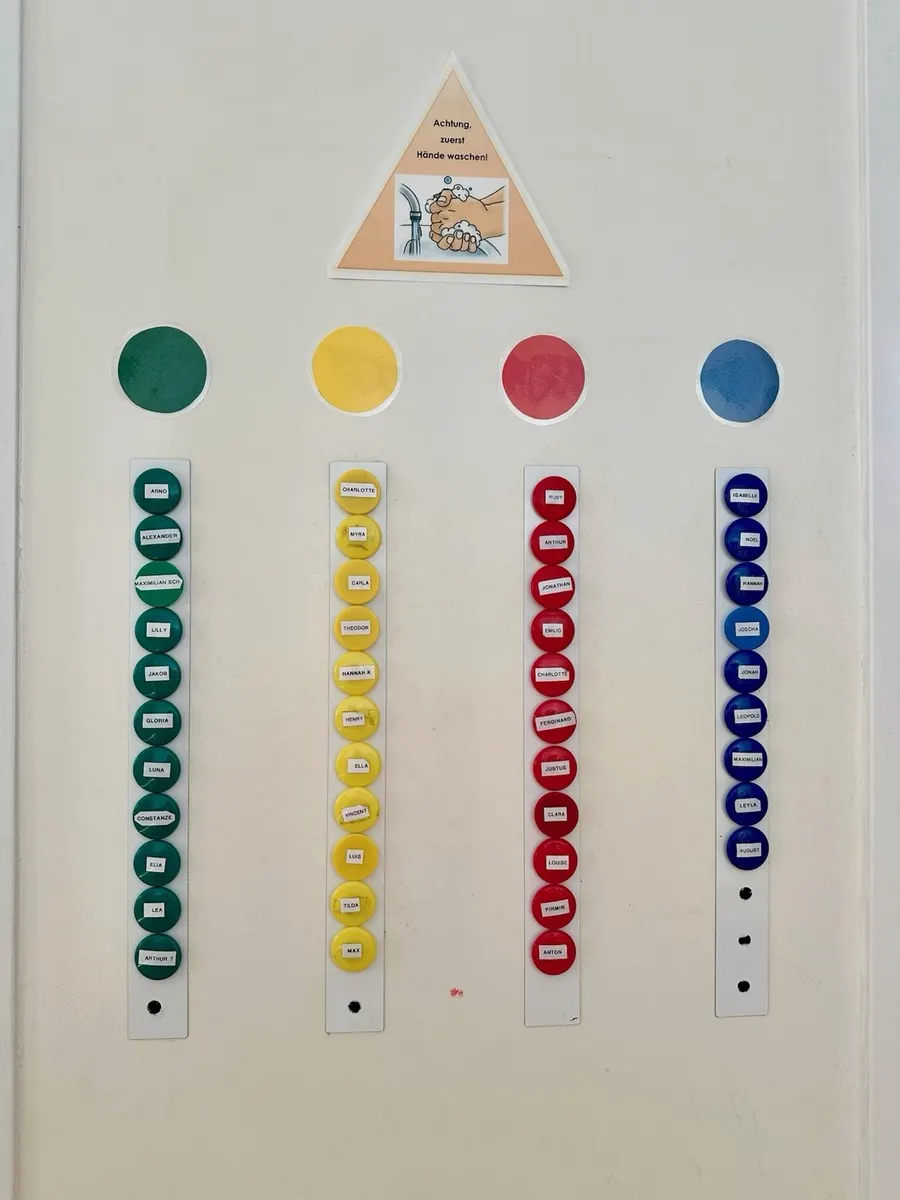
The solution is deliberately simple: every child has their own magnet button. Before going in, they stick it on the magnetic strip beside the door frame. One glance is enough to see whether there is still room.
No adult has to allocate places, no child has to ask. The children manage the rooms themselves — and learn to be considerate and to make decisions in the process.
Every room follows the principle of the prepared environment: the furniture, the materials and the order are matched to the children, not to the adults.
Language, mathematics, sensorial materials, exercises of practical life, and materials for exploring the world.
Trying out tools and techniques, working with fine motor skills — freely or following instructions.
Hengstenberg equipment and psychomotor materials, in settled groups with their key educator.
A doll's kitchen with a seating area, a shop and a dressing-up box — and the reading sofa.
Constructing, stacking, knocking down and rethinking.
Where the mid-morning snack is made, prepared together at a worktop built for children.
Our educational aims in the Children's House span five dimensions — they interlock; none stands on its own.
Recognising and expressing one's own feelings and respecting those of others. Meeting a challenge without needing help straight away.
Treating one another attentively, taking responsibility for oneself and for the group, resolving conflict fairly.
Noticing the variety of cultures and the beauty of the natural world — through outings, projects and living through the seasons.
Building an understanding of mathematics and language through play: numbers, shapes, quantities, patterns of language and rhythm.
Making democracy something children experience: they learn that their voice counts, and they are involved when decisions are made and when complaints are raised.
Children do not develop evenly, but they do develop in recognisable phases. These three shape the Children's House years.
A great deal of time in the building and doll corners. Of the Montessori materials it is above all the sensorial ones that speak to them — grasping in the literal sense.
Letters and numbers become interesting, along with cosmic subjects such as maps and the seasons. Motor and social skills grow alongside.
Personal, social and cognitive competences are built up further. The children carry themselves with growing confidence, including in unfamiliar situations.
A Montessori educator's role has two halves: going towards the children, and stepping back. Offering a stimulus, introducing a material, observing — and then leaving room.
All our educators are qualified practitioners and additionally hold the Montessori diploma. Alongside their work they add qualifications such as psychomotor education and the Hengstenberg method; this training is recognised under the Hessian framework for education and care.